Is Dinner Ready? Or Is the Novel?
Dear Friends at the Table, Cara amici a Tavola,
Here I am in Portugal, supposedly walking, wandering, eating, and absorbing the life around me. Instead, I've somehow wandered into the winding archives of my own writing.
One memory led to another. Arles. A room tucked beneath the eaves. A novel that wouldn't behave. And then I found this old essay from January 2011.
At the time, I was revising the Bécasse novel, which would eventually become “The Mistress of Apples and Bécasse”, published in 2025.
Fourteen years later!
Apparently, some dishes require a very long, very slow simmer.
Reading this now, I'm amused to discover how little my feelings about writing have changed. I still love the moment when everything is possible, when the characters surprise me, when the ingredients are assembled but the final dish has yet to reveal itself.
And I still believe that sometimes you must read between the lines of your own writing.
So here's the original, from a kitchen—and a writing desk—some fifteen years ago.
Pass the butter. And has anyone seen the rolling pin?
The original January 2011 essay, preserved in its original voice.
“Is dinner ready?” asks the voice from the other room.
(Since they have to ask, chances are they aren’t in the kitchen working with you) and … maybe you don’t want them to be!
And whether you are working on novels or dinner, everything has its own time.
What part of writing is your most favorite? Least?
I started revising the Bécasse novel so I am back at it, which I love, but the story is changing, and that part is trouble.
So I chuckle and sigh and then feel defeated when I hear how a novel can be written in a year.
Or a meal can be prepared in three minutes, or some other rather abbreviated time in the kitchen.
Sure, I can write a first draft in a year. And maybe a second draft…but..
And as for dinner, in 3 minutes I might craft an amuse bouche, which is an amusement for your mouth.
Something like a sliver of zucchini and a basil leaf rolled around, snuggly wrapping a smear of goat cheese. A few walnuts?
A fantastic but momentary dalliance for your tongue.
But alas, there’s more work ahead.
Like when, after writing the first draft - the sweaty work of revising this literary piece de resistance is very much still ahead.
After the amuse bouche, comes the sweaty work of chopping and sautéing and stirring and deglazing, and then reduce the heat to simmer; steep the flavor from the bones, the peels.
But this is the part I love; the deep aromas, the examining…when everything is still possible.
What part of writing is your most favorite? Least?
At this point in the process it is a blessing to see the many possibilities for a story.
In terms of dinner, you are standing on the precipice. (is it made of bacon? or a fragile crispy shard of phyllo dough? It’s up to you!) so please remember that too many flavors can mar a dish.
It is useful, imho, to sit at the table with your characters. Then you might notice that someone is not eating. or eating everything.
One person is talking on.
And on.
Then they take a sip, and the conversation waivers.
And that’s when a transition occurs in your work.
Maybe like a brace of carrots prepared using your intuition, (and coriander?) the evening and the dish edge into another realm.
An experience that cannot and should not be replicated.
But you have no idea why. How you did it.
When you try to examine it, it scurries up and out the door, wanders off into the forest, inviting you to find it.
Getting it right on the page is a bit more nefarious, slinky and deceiving than kitchen work can be.
Bread is either baked or it is not. Cake is perhaps too salty or perfect. But it is never bread. No. It is not.
With a story you cannot put it on the table and walk away waving your hand in exclamation; "if that doesn’t suit you, just wait till the next course. it’ll knock your socks off."
You’ll find your diners have left.
The book has been closed and pushed away, across the table.
Readers want to feel at home in your story.
Dip their spoon into a rich mélange of parsnips and rosemary.
So how do you get there?
Sometimes a scene written because of a hunch or wild dash of emotion can bear a clue about the turning points in a story.
You raise a question at dinner, no one’s considered. The one person who was talking, yes, that one, stops to look and think. This is going somewhere good, somewhere the table has not been before. Yet, you don’t know, it might be the last dinner you all ever share.
Back to themes, sometimes bacon can tie together the courses of a meal. Or chocolate. There must be a unifying element.
(You can of course choose your taste theme. Maybe it rockets back and forth between bacon and chocolate.)
When you reread, it hits you. The main issue. The smaller ones, all lined up like ingredients.
Oh my god, really. he said that? Then that means that ..yes, I can hardly believe it. He does like liver.
You must be able to read between the lines of your own writing.
Examine what worked in a dish and what did not.
And then this dense and wily introspection will lift many more platters, carefully garnished onto the white linen or if you prefer, will spill a heap of just boiled and steaming crawfish out on the layers of newspapers.
With your fork (sometimes you’ll need a sharp knife to slice open the rolled and stuffed pork loins; which, I know you didn’t notice on the large festooned platter, because of the crawfish getting all the attention.. but now that I look more closely, aha, I see the roast stuffed pork loins are really aubergines, eggplants, oh, of course.) you’ll spear the most delicious bits.
You’ll admire the spectacle of dishes in the candlelight.
A perfume of toasted fennel seeds, your lips enfold the first morsel; a slightly charred crispy bit of skin, and you ask yourself, is the sweetness from honey or raw sugar sprinkled over at the last moment?
Does the dish sing?
What is this story about?
Only you can decide.
And then it's back to the kitchen to do the dishes.
A little afterword, October 2026
And here I am, fifteen years later, sitting in a café in Olhão, Portugal, still trying to figure out when a story is finished.
Rich is having a cappuccino. Somewhere nearby there's a woman with a paint scraper and a Chihuahua. Or perhaps we're talking about walking to see the five statues.
I may have lost the thread.
But isn't that how stories begin?
Meanwhile, the Bécasse novel finally made it to the table in 2025.
Explore the book and choose your favorite bookseller.
But the lesson remains: stories, like good meals, take the time they need.
And somebody still has to do the dishes.
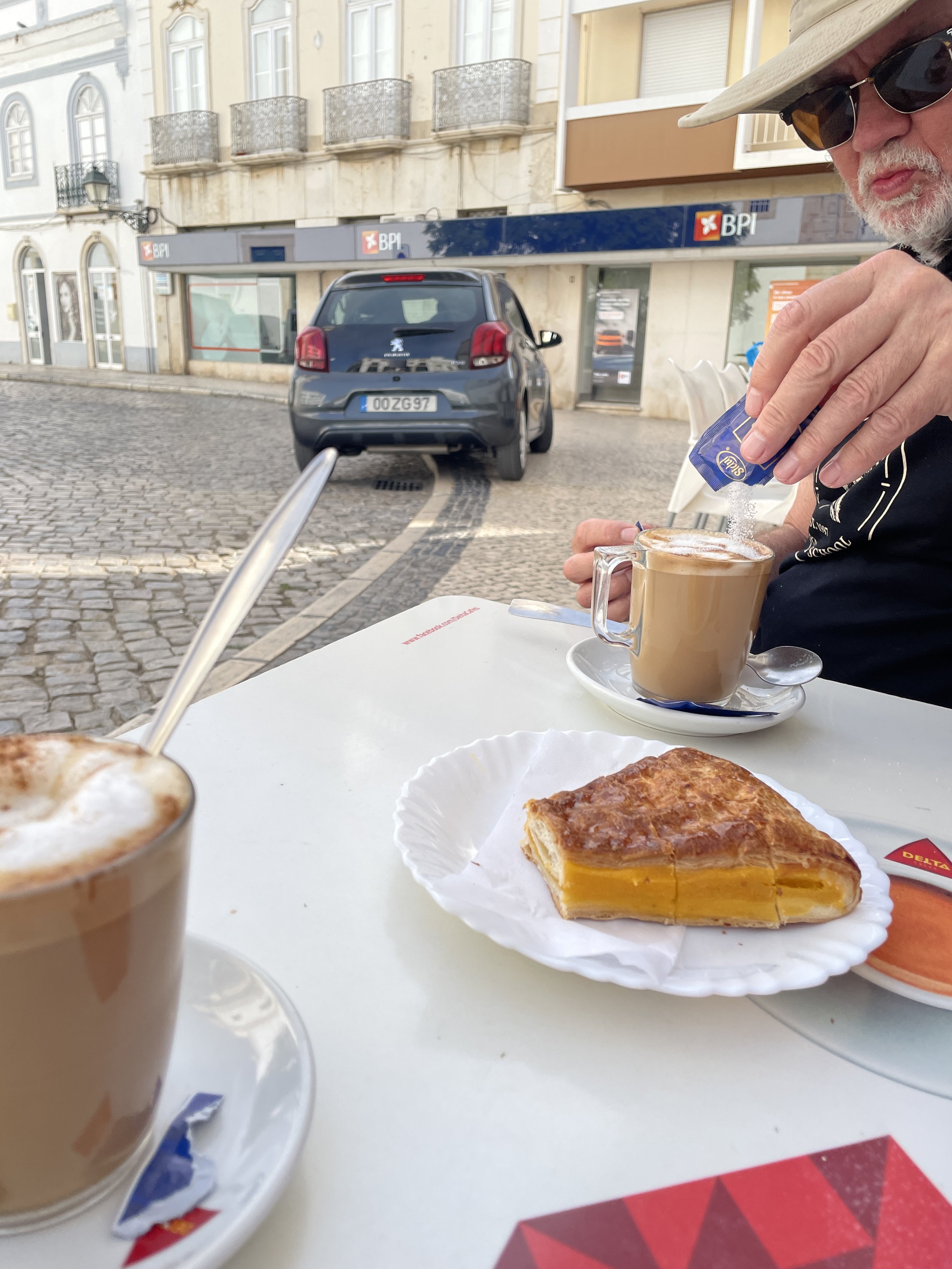
The best place to look out for more fish and stories. Or statues. A cafe on a busy street in Portugal.